
Experience
I’ve spent my career designing and delivering clinical technology systems that move from concept to real-world deployment—spanning bedside devices, enterprise cardiology platforms, and AI-driven clinical analytics.
My work sits at the intersection of:
- clinical workflows
- medical device engineering
- regulatory execution
- healthcare data interoperability
I’ve led development efforts across organizations including GE Healthcare, Cerner, and Lumedx, with a focus on building systems that are not just technically functional—but clinically usable and commercially viable.
Marquette Electronics - Built foundational experience in ECG acquisition systems and clinical workflows.
Early Career: Clinical Systems and ECG Infrastructure
Context
Worked as a field engineer supporting cardiology diagnostic systems across hospital environments, gaining direct exposure to how clinical data is acquired, processed, and used at the bedside.
What I Did
- Installed, maintained, and troubleshot ECG acquisition and cardiology diagnostic systems in live clinical settings
- Trained on early-generation computing platforms (DEC 11/23, CDC storage systems) supporting medical data workflows
- Worked directly with clinicians to resolve real-world system and workflow issues
What This Built
- Deep understanding of how clinical data originates at the point of care
- First-hand experience with failure modes in real hospital environments
- Foundation in cardiology signal acquisition and system reliability
.

Early cardiology data systems (CDC 9448 drive). These environments shaped my understanding of how clinical infrastructure actually behaves under real-world constraints.
Cardiac Analysis Center - Worked on early remote ECG transmission and automated interpretation systems—precursors to modern telecardiology and cloud-based diagnostics.
Early Remote Cardiology Systems
Context
Recruited by a group of cardiologists to help build an early-stage remote cardiac diagnostics platform—designed to receive and process ECG data transmitted over telephone lines.
What I Did
- Contributed to development and deployment of a system that received trans-telephonic ECGs into a centralized computing environment
- Supported implementation of automated ECG interpretation workflows with cardiologist over-read
- Worked across clinical and technical boundaries to ensure data accuracy, transmission reliability, and usability in real-world settings
What This Built
- First-hand experience in remote physiological data acquisition and transmission
- Early exposure to automated interpretation + human-in-the-loop clinical validation
- Understanding of distributed diagnostic systems, now foundational to telemedicine and cloud-based healthcare platforms
This work represented an early form of remote cardiac diagnostics—an architectural model that underpins today’s telemedicine and cloud-based ECG systems.

Early remote ECG processing environment. Systems like this established the foundation for modern telecardiology workflows.
Marquette | GE Healthcare - Led product and field efforts for cardiology information systems, bridging product development, clinical workflows, and enterprise deployment.
Cardiology Systems, Product Management, and Market Deployment
Context
Returned to Marquette Electronics and transitioned into product management during the evolution into GE Healthcare, focusing on cardiovascular information systems and enterprise cardiology solutions.
What I Did
- Managed product development for cardiology information systems, including exercise testing and data management platforms
- Defined product requirements based on real clinical workflows and customer needs
- Supported deployment and adoption of cardiovascular systems in hospital environments
- Worked in both product management and field roles, aligning engineering, sales, and clinical users
What This Built
- Deep experience in designing clinically usable cardiology information systems
- Understanding of how products succeed or fail in real hospital deployments
- Ability to translate between engineering teams, clinicians, and commercial stakeholders
Over ~15 years at Marquette and GE Healthcare, I contributed to the evolution of cardiology diagnostics from standalone devices to integrated, enterprise-level information systems.

Cross-functional teams developing early cardiology information systems at Marquette/GE Healthcare.

Clinical deployment environments where cardiology systems were implemented and validated.

Early role in cardiovascular information systems consulting within GE Healthcare.
Mortara Instrument (now Hillrom) - Led development of DICOM-based ECG storage, helping establish the global standard for enterprise cardiology data integration.
Industry Impact: DICOM for ECG
Defining ECG Data Standards and Enterprise Integration
Context
Recruited from GE Healthcare to Mortara Instrument to lead product efforts in ECG systems during a period of transition toward enterprise and network-based healthcare infrastructure.
What I Did
- Led product strategy and development for ECG systems with a focus on enterprise integration
- Drove adoption of enterprise WiFi capabilities, including support for secure hospital network environments (LEAP/enterprise authentication)
- Authored and delivered technical positioning materials to hospital CIOs, aligning product capabilities with emerging IT requirements
- Played a key role in enabling 12-lead ECG data storage within PACS systems using DICOM standards
What This Achieved
- Helped establish DICOM as a viable and scalable standard for ECG data storage and interoperability
- Enabled ECG data to be integrated into enterprise imaging and clinical systems alongside radiology and other modalities
- Contributed to a shift toward centralized, accessible cardiology data within hospital IT infrastructure
This work contributed to the adoption of DICOM for ECG as a global standard, fundamentally changing how cardiology data is stored, accessed, and integrated across healthcare systems.
Industry Impact: DICOM for ECG

Played a key role in advancing the use of DICOM for 12-lead ECG…

🏆 Frost & Sullivan Best Practices Award (2008)

Cerner - Scaled DICOM-based ECG integration within Cerner Millennium, enabling global deployment of enterprise cardiology workflows.
Recruited to Cerner as a cardiology strategist to scale DICOM-based ECG integration within the Cerner Millennium platform.
Enterprise Deployment of DICOM ECG within EHR Systems
Context
Recruited to Cerner as a cardiology strategist to expand and operationalize DICOM-based ECG integration within the Cerner Millennium platform.
What I Did
- Led strategic positioning and adoption of DICOM ECG within Cerner’s enterprise EHR environment
- Worked with engineering, sales, and clinical stakeholders to integrate ECG workflows into PowerChart
- Supported global deployments across international and U.S. healthcare systems
- Helped transition ECG from a standalone system into a fully integrated component of the patient record
What This Achieved
- Expanded DICOM ECG from limited adoption to global deployment within Cerner Millennium
- Enabled clinicians to access ECG data directly within the EHR alongside other clinical information
- Contributed to the success of PowerChart ECG as an enterprise cardiology solution
DICOM ECG overreading in Cerner Millenium:
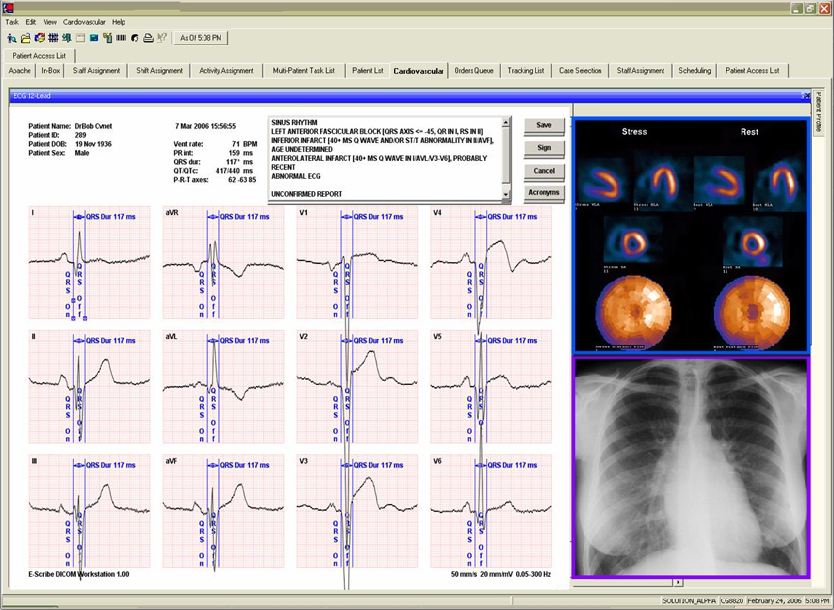
DICOM-based ECG integrated into Cerner Millennium (PowerChart), enabling unified cardiology workflows within the patient record.
Lumedx (now GE) - Led development of a SaaS-based ECG management platform from concept to delivery, competing with established systems like GE MUSE.
Building an ECG Platform from the Ground Up
Context
Joined Lumedx as Director of Product Management to lead strategy across cardiology and diagnostic systems, with a focus on building next-generation clinical platforms.
What I Did
- Led development of an ECG management system from the ground up, including architecture, product definition, and execution
- Relocated to Pune, India to build and manage an offshore engineering team
- Designed a SaaS-based cardiology platform integrating ECG data, workflows, and clinical reporting
- Implemented interoperability capabilities, including HL7-based interfaces and enterprise integration
- Drove product direction to compete with incumbent systems such as GE MUSE and Epiphany
What This Achieved
- Delivered a fully functional ECG management platform built from first principles
- Established a scalable architecture for cloud-based cardiology systems
- Demonstrated ability to execute complex product development across distributed teams
This initiative represented a full-cycle product effort—from concept through architecture and delivery—marking a defining point in my work building clinically relevant, commercially viable healthcare systems.


Engineering team in Pune responsible for development of the ECG platform. Early mobile access to ECG data—precursor to modern mobile clinical workflows. Product and architecture planning during system development.
Excel Medical (now Hillrom) - Worked on early real-time patient monitoring data extraction and analytics platforms, enabling continuous physiologic data streaming and downstream predictive use cases.
Real-Time Physiologic Data Streaming and Analytics
Context
VP of Clinical Informatics for Excel Medical (now Baxter)
What I Did
- Led the team that created the first FDA-cleared physiological edge server to interface with Epic via a FHiR framework to provide real-time waveforms via the EMR
- Contributed to development and positioning of a system that captured real-time physiologic data directly from patient monitoring networks
- Supported transformation of network-based monitoring data into a usable software platform (“Bedmaster”)
- Helped enable access to continuous patient data streams, including heart rate and waveform data
What This Built
- Early experience with real-time clinical data streaming architectures
- Exposure to continuous physiologic monitoring and data extraction at scale
- Foundation for predictive analytics use cases, including heart rate variability and patient deterioration analysis
This work represented an early step toward modern predictive monitoring—transforming continuous physiologic data into actionable clinical insights.


Real-time physiologic waveform capture from patient monitoring systems. (shown here inside Epic EMR) Early data extraction and analysis interface for continuous patient monitoring data.
Dassault Systems - Led life sciences R&D initiatives focused on applying simulation, data, and digital modeling to clinical and medical device systems.
Simulation, Digital Twins, and Clinical Systems
Context
Joined Dassault Systèmes as Life Sciences R&D Experience Director during the company’s expansion into healthcare and life sciences, bridging engineering simulation technologies with clinical and medical device applications.
What I Did
- Led initiatives exploring the application of simulation and digital modeling to medical devices and clinical systems
- Worked across Dassault platforms (SIMULIA, BIOVIA, Medidata) to align engineering and life sciences capabilities
- Contributed to early efforts in applying digital twin concepts to cardiovascular systems and device design
- Collaborated with regulatory stakeholders, including the FDA, to evaluate how simulation could support future clinical and regulatory workflows
What This Built
- Deep understanding of digital twin and simulation-based approaches in healthcare
- Experience bridging engineering simulation and clinical application domains
- Early exposure to next-generation clinical system design and predictive modeling
This work explored how simulation and digital modeling could influence the future of medical device development and clinical decision-making—an area now emerging as a key direction in healthcare innovation.
Warable.ai
Founder & Chief Architect — Warable.ai
Founder and Chief Architect, Warable.ai — developing a multimodal physiological monitoring and AI-driven health platform integrating wearable sensors, mobile applications, cloud analytics, predictive modeling, and healthcare interoperability.
. Fig 1  Fig2
Fig2  Fig3
Fig3
Project Experience
Selected projects demonstrating end-to-end development of clinical systems—from device integration and regulatory clearance to cloud-based platforms and AI-driven analytics.
Establishing DICOM as a Standard for 12-Lead ECG Integrationc

Early example of ECG data integrated into enterprise imaging workflows using DICOM.

Frost & Sullivan Best Practices Award (2008) recognizing market impact of DICOM-based ECG integration.
FDA-Cleared Edge Server for Real-Time Physiologic Data Integration
Delivered one of the first FDA-cleared systems to stream real-time physiologic data from bedside monitors into the EMR.
Context
Hospital patient monitoring systems generate continuous physiologic data, but historically this data has been difficult to access in real time within electronic medical record (EMR) systems.
What I Did
- Led development and positioning of an edge server platform to interface directly with hospital patient monitoring systems
- Enabled near-real-time streaming of physiologic data and waveforms into enterprise clinical systems
- Designed architecture to support secure, scalable integration with EMRs, including FHIR-based interfaces
- Navigated regulatory requirements to achieve FDA clearance
Outcome
- Delivered one of the first FDA-cleared physiologic data interfaces bridging bedside monitoring systems and EMRs
- Enabled clinicians to access real-time waveform data within platforms such as Epic (Haiku)
- Established a foundation for continuous monitoring, analytics, and clinical decision support systems
Why It Matters
This work helped close the gap between real-time patient monitoring and enterprise clinical systems, enabling a shift toward continuous data-driven care rather than episodic data capture.


Real-time physiologic waveform streaming from bedside monitors. Structured physiologic data captured and integrated into enterprise systems.
SaaS Cardiology Platform Developed from Concept to Prototype
Context
The company faced margin pressure in its existing cardiology offerings, requiring a shift toward a more scalable and differentiated platform strategy.
What I Did
- Led development of a market strategy and product roadmap for a cloud-based cardiology data management system
- Transitioned from strategy to execution, defining system architecture and product requirements
- Built and managed a distributed engineering team in Pune, India
- Delivered a working proof-of-concept in ~5 weeks, demonstrating feasibility and direction
Outcome
- Established a foundation for a SaaS-based cardiology platform
- Demonstrated rapid execution from concept to working system
- Enabled strategic pivot toward scalable, cloud-based clinical systems
Why It Matters
This project demonstrated the ability to move from business problem → product strategy → working system quickly—an approach essential for modern healthcare startups and innovation initiatives.


Engineering team in Pune responsible for rapid prototype development. Early prototype of cloud-based cardiology data management system.
AI-Enabled Clinical Data Platform Integrating Wearable and Medical Data
The project specs included the ability to upload PDF data to the cloud to be augmented by real-time wearable device data that collected heart-rate variability data.


Early prototypes of unified clinical data interface combining ECG data and patient records.
Predictive Remote Patient Monitoring Platform for Middle-Acuity Care
Context
Traditional patient monitoring systems are designed for high-acuity hospital settings and fail to address the large population of “middle-acuity” patients who require continuous oversight but not ICU-level care.
What I Built
- Designed a compact physiological data platform for continuous patient monitoring outside traditional clinical environments
- Captured real-time physiologic signals including ECG, SpO₂, temperature, and motion data
- Enabled local processing and edge analytics to support early detection of clinical deterioration
- Architected system to integrate with cloud platforms for longitudinal data analysis and alerting
Core Innovation
- Bridges the gap between episodic clinical data and continuous physiologic monitoring
- Supports predictive analytics workflows, not just retrospective review
- Designed for deployment in home, ambulatory, and lower-acuity care settings
Outcome / Direction
- Forms the foundation for a new category of middle-acuity monitoring systems
- Aligns with emerging healthcare models focused on remote care, early intervention, and cost reduction
- Supports integration with AI-driven health platforms and wearable ecosystems
Why It Matters
Healthcare is shifting from reactive treatment to continuous monitoring and prediction. This system reflects that shift by enabling real-time data capture and analysis outside the hospital, where most patient deterioration actually begins.
This concept aligns with my ongoing work in wearable physiologic monitoring (PICSI) and cloud-based health data systems.
